
China and IEC can cooperate very well for the future
—Interview with Mr. Vimal Mahendru, IEC Vice-President and Chair of SMB
中国与IEC深化合作 共创未来——专访IEC副主席兼标准化管理局主席 维马尔·马亨德鲁
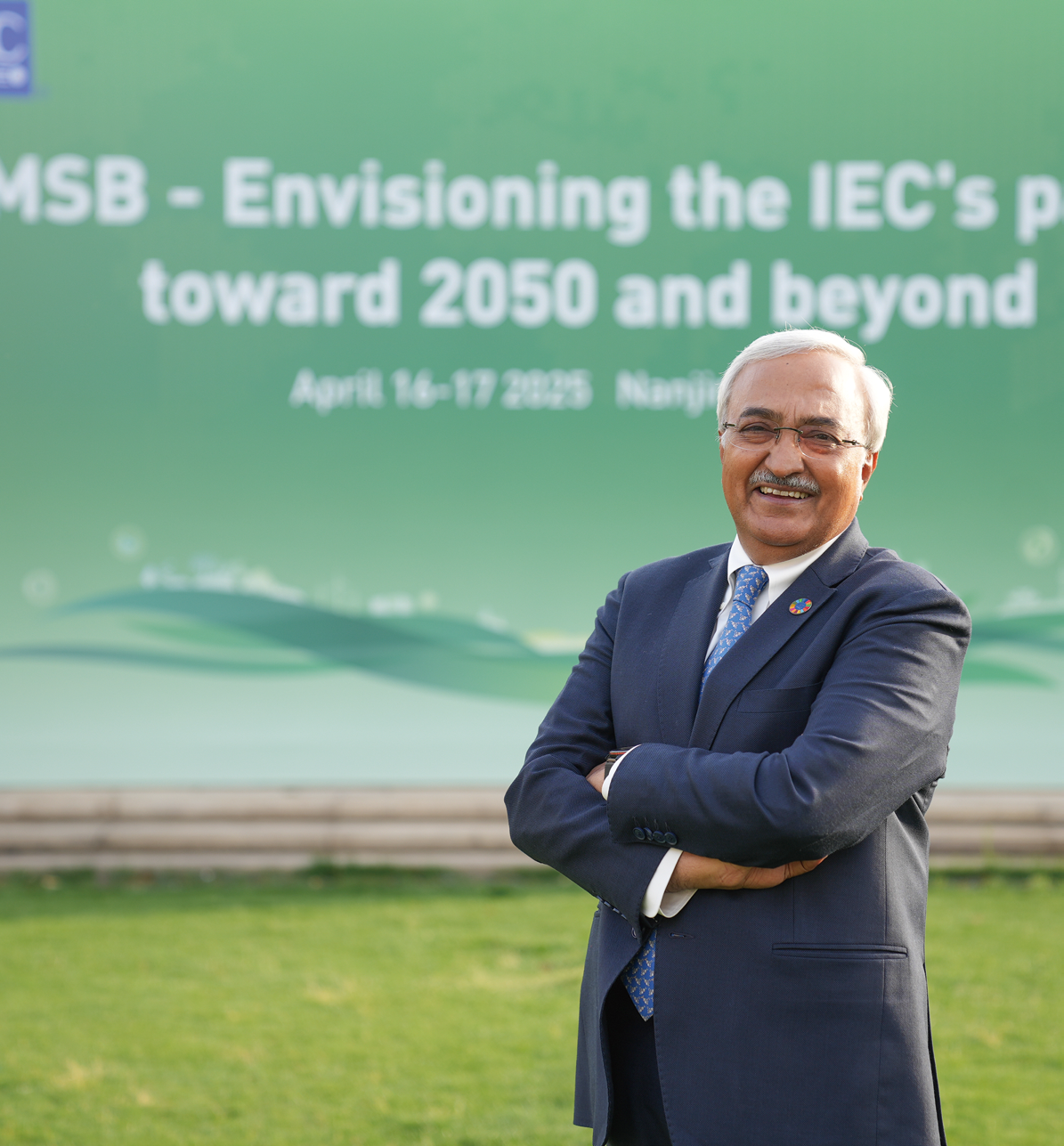
China Standardization: You have served many leading roles in IEC. Can you share with us your main professional experience, in particular how did you get involved in the IEC standardization work?
Mr. Vimal Mahendru: I was born in a small town in north India. My father was very hard-working, and in 1958 he set up a company for making electrical switches. He made switches with his hands, and then sold them in the market. It was a very small business. I grew up seeing him working hard with the electrical equipment, which gave me some ideas about electricity. Growing up in a small town, I was very clear that I had to work hard to become an engineer and study hard to develop myself.
So I became an engineer. Then I went to the U.S. to study my master courses. Later, I came back to India and joined my father in the business of making low-voltage electrical equipment. We did well to make the business grow to a good size in India. Then I became a member of the vibrant Indian Electric and Electronic Manufacturers Association (IEEMA). I became its president in 2010. Around that time, the business had grown so much that my family decided to sell it to a French company. We sold the business, and I began to lead the French business in India.
At that time, the Indian government was looking for people who could lead the work of electrification for the country. I got involved in working with the government to make a policy for electricity access. But we needed standards, so we went to the IEC headquarters in Geneva for the standards for rural electrification. In IEC, they said, “Well, good idea. But if you need standards, you must be part of the committee to chair it and lead this work”.
It was in 2014 that for the first time I got involved in IEC to enable writing the standards for electricity access. I was lucky that in the same year I got elected to the Standardization Management Board (SMB) as a member representing India. Since then, I had been a member of the board for 8 years. In 2022, the IEC community almost unanimously voted me as the Chair of the board. That is my journey in becoming the IEC SMB Chair and Vice President.
How does IEC collaborate with other international standards organizations including ISO and ITU in developing harmonized international standards, especially those for digitalization?
The collaboration works at many levels. The first level is the World Standards Cooperation (WSC). This is a cooperation forum where the leaderships of IEC, ISO and ITU, the presidents, secretary- generals and vice presidents, meet once a year to discuss the global agenda. We coordinate with each other, and pull our resources to write standards.
The second level is the standardization level. IEC, ISO and ITU come together in the Standardization Programme Coordination Group (SPCG). The SPCG has regular meetings every year, to look at the complete standardization programmes of IEC, ISO and ITU, and make sure that we are not doing the same thing and we don’t leave a vacuum that nobody is doing. That becomes a very important part of our coordination.
The third level is actually where we write standards. In the technical committees in IEC, ISO and ITU, there are a lot of members who sit in each other’s technical committees. We have a formal structure called liaisons. These liaisons work both ways. For example, ambassadors of a technical committee in IEC go to the other committee in another organization like ITU or ISO to share what we have done and listen to what their need is, and then bring it to IEC. This is how at three levels the cooperation and coordination on standardization works.
In the area of digitalization, there is a lot of coordination going on. Especially IEC and ISO have a joint delivery program where we are totally synchronized on our digitalization efforts. IEC and ISO have coordinated to make the standards development process in a digital way on the Online Standards Development (OSD) platform. The OSD is a common platform of IEC and ISO where all future standards are going to be written. It has been already implemented since January this year. All experts worldwide in IEC and ISO are expected to be using this platform to write standards. Also, we are writing digital apps and the digitalization of standards is going on. There is a lot of work to be done. IEC and ISO have formed a joint operational team, which will implement the complete digital transformation of standards in IEC and ISO. From users’ perspective, they see only one app and a clear transparent view of the digitalized version of standards.
The cooperation of IEC, ISO and ITU is very cordial. For example, as Chair of IEC SMB, I sit on the Technical Management Board (TMB) of ISO and the Chair of ISO TMB sits on the IEC SMB. So, the chairs are sitting on each other’s boards, and they bring information from their respective organizations to the other. This is good cooperation. We make sure that these are two separate organizations, so they make their own decisions. But to understand what is going on, we sit with each other to coordinate.
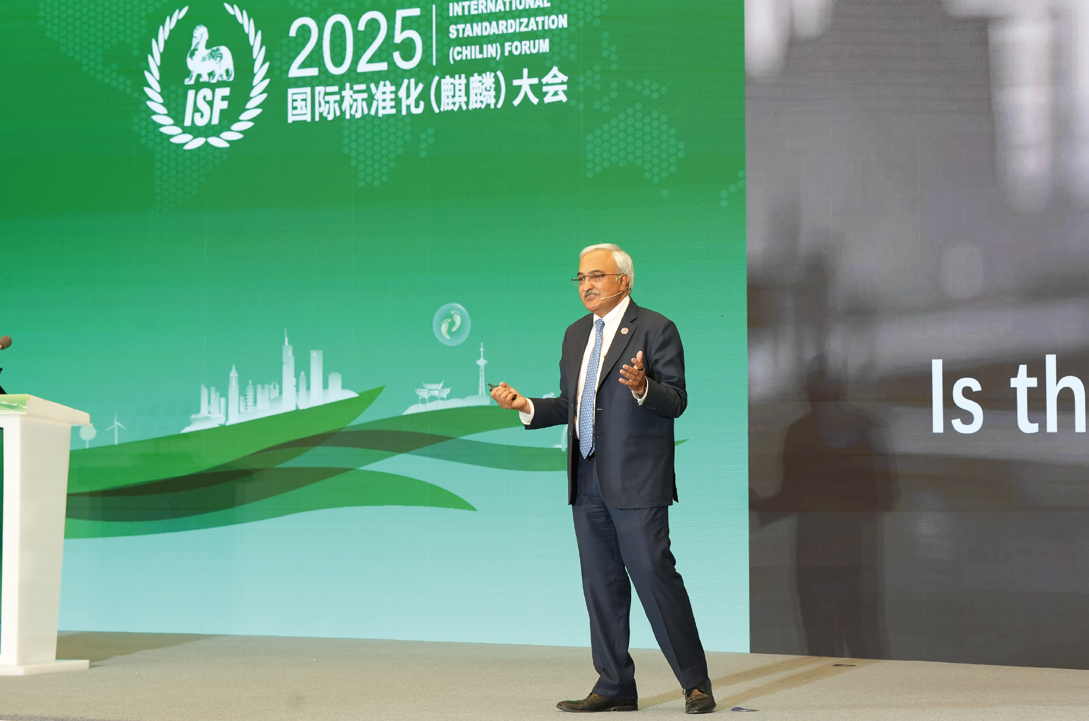
Vimal Mahendru gives a speech at the 2025 International Standardizaton (Chilin) Forum held in Nanjing city, Jiangsu province, China.
In your opinion, what are the biggest challenges faced by the current IEC standardization work system?
The first challenge is that we don’t have everyone sharing their problems or issues with us. There are some countries that are leading the standardization work, sitting at the table, writing the standards, and defining the problems that the standards solve. But there are many countries that are not even telling the IEC the challenges they may be facing. They are not even articulating what they need from the standards. That is a challenge to really develop globally relevant standards. We need every country to come in and share what issues they have, so that the solutions that the standards bring can serve the whole global community.
The second challenge is that technology is changing very rapidly. For instance, digital transformation, sustainability, circular economy, hazardous materials, resilience, and AI. These are changing very fast in the last 10 years. Even before standards are written, policy makers worldwide and regulators are stepping in and they are making policies around AI, circularity and other major shifts in society. This tells me that IEC must do a better job of engaging with policy makers and understanding what governments and policy makers want, in order to address them speedily through our standards. This means we need to listen to governments and policy makers more in the future. This is important.
The third challenge is with so many disruptive technologies, I find that IEC is going at a certain speed, which is okay when a technology is not changing. But today when the technology is evolving very rapidly, we need to be faster and understand new technologies and start the standardization. You will see in the coming months and years, IEC will be a lot more engaged and responsive in addressing the changes in society and bringing those changes in a standardized way much faster.
With the ever-changing global landscape and rapid development of emerging technologies, what are the priorities of IEC standardization work this year or in the next few years? How is China doing in these areas?
In my opinion, the first priority is smart and sustainable cities and communities. This is very important. The majority of the world today lives in cities and communities. Are we living better than 20 or 30 years ago, or is the quality of life going down? It has to continue to improve. To this end, IEC and ISO have recently formed a joint technical committee on smart and sustainable cities and communities. This is pivotal work. I welcome China to partner in this, bringing Chinese experts to contribute their knowledge and experience to the smart and sustainable cities.
The second priority is sustainable electric transport. China has done an amazing job in this area. If you see the fleet of electric vehicles, not only personal vehicles but also commercial vehicles and public transport, you will know that China has done very well. I congratulate the Chinese industry and its leadership. This is required by the world. So sustainable electric transport is another work that IEC is doing. This is very relevant today. This year we are going to do a lot of work in this. I sincerely welcome Chinese experts to be involved in this.
The third priority, which was also the theme of this year’s International Standardization (Chilin) Forum, is carbon-free energy and clean energy technologies. This is at the heart of development. Today there is almost nothing you can do without electricity, electronics, or software. These technology domains are at the heart of IEC. This is the reason why IEC standards are written. We are working toward an all-electric and connected society. It becomes very important to write standards which bring clean energy and carbon-free electricity to all. China has a lot of experience in this area, which I believe is very significant to the world. Thus, bringing relevant Chinese knowledge to IEC would be very helpful.
China has played an increasingly important role in developing and promoting IEC standards. What areas can China and IEC carry out in-depth cooperation for mutual benefits and global well-being?
There are a lot of them, for example quantum technologies, biodigital convergence, and space technologies. Energy efficiency is already a big topic in China. But the future is about zero-energy and zero-emission buildings. How can we make sure that a building becomes so self-sufficient in energy that it doesn’t take anything from the grid and doesn’t emit any smoke or pollution? This is the future. Those are areas where China and IEC can cooperate very well.
I want to conclude by quoting a beautiful sentence that I saw in the exhibition center of the IEC Promotion Center (Nanjing) this morning: “China is becoming more and more important to IEC, and IEC is becoming more and more important to China”. I totally believe in that.
采访/靳吉丽 (Interviewed by Jin Jili)
About Mr. Vimal Mahendru:
Mr. Vimal Mahendru began his three-year term as IEC Vice-President and Chair of SMB on January 1, 2023. He has been deeply involved in many IEC activities for more than 11 years. Mr. Mahendru is currently the IEC Special Envoy for UN SDGs, member of the IEC Board Task Force on UN SDGs, member of the IEC Business Advisory Committee (BAC), and Chair, and Convenor or Co-Convener for several SMB related boards, strategic groups, and ad hoc groups. He is also Chair of the IEC Systems Committee for Low Voltage Direct Current and Low Voltage Direct Current for Electricity Access (SyC LVDC). Additionally, he is the CEO of Valuon Strategic in India, and a member of the Electrotechnical Divisional Council of the Bureau of Indian Standards.
