
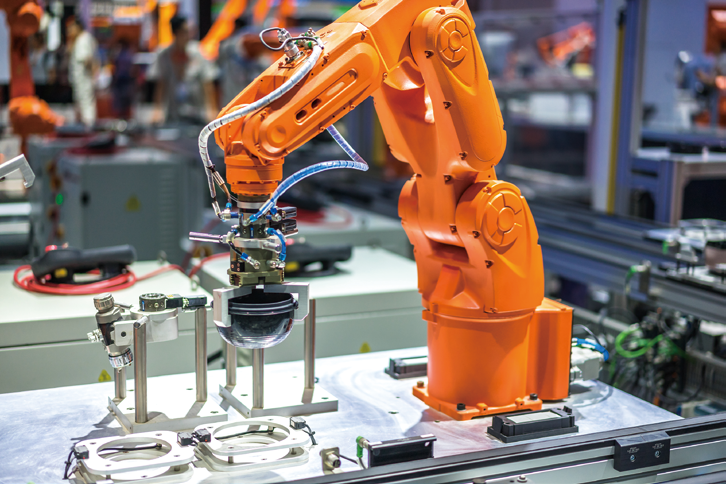
China has ascended one of the global manufacturing powerhouses, greatly supported by the achievements of intelligent manufacturing engineering. Its intelligent manufacturing standardization has entered a critical stage of forward-looking planning and proactive leadership.
The 2026 annual plenary meeting of the National Intelligent Manufacturing Standardization General Group and Expert Advisory Group was held in Beijing on April 14.
The meeting called on the two groups to focus on frontier areas, accelerate the development of critical standards, iteratively upgrade the standards system, fully leverage the coordinating role of the groups, and strive to resolve issues such as overlap and duplication in standards proposals.
With the development of AI, a new generation of intelligent manufacturing systems is urgently needed to support the transformation of manufacturing models, said Yu Haibin, Academician of the Chinese Academy of Engineering and Director of the Institute of AI for Industries, Chinese Academy of Sciences, in his report titled “Intelligent Manufacturing in the Age of Artificial Intelligence.” He suggested conducting research on four types of standards for various business domains: framework models, technical requirements, evaluation specifications, and integration applications.
Zhang Xiaogang, former President of ISO, believed that standardization internationalization represents the key to global industrial competition. China should actively participate in the formulation of international rules, promote the “going global” of Chinese standards, and utilize standards to facilitate technological innovation and trade.
During the 15th Five-Year Plan period, cross-industry standards coordination, forward-looking systematic planning, and deeply integrating standards with industrial application scenarios will be strengthened to provide solid support for the high-quality development of intelligent manufacturing.
